Showing posts with label #stevenmoffat. Show all posts

Tuesday, December 26, 2017

Doctor Who Review: Twice Upon a (Mediocre) Time


Twice Upon a (Mediocre) Time
a Doctor Who Review
Warning: *Spoilers*

We were fortunate this holiday season to be able to see the Doctor Who Christmas special on the night it broadcast in the U.S. I'd like to say we were fortunate to have seen a first rate send-off for Peter Capaldi's Doctor, but sadly we did not. 

First thing I have to mention is that I can't stand the sheer amount of commercial interruptions BBC America incorporated into the episode. Possibly there was a decent story hidden somewhere in between the copious amount of ad breaks, but they were enough to zap any interest either one of us had in the show from one scene to the next. And that says something for itself right there--if there had been a engaging storyline, then no amount of commercial interruptions would have caused us to channel surf and lose interest.

While David Bradley's portrayal of the First Doctor is superb, was his character really necessary in the story at all? Was the character of Bill necessary? Essentially, the premise is about the Christmas Truce of 1914. We have an English captain, played by screenwriter/actor Mark Gatiss, come along for a ride in the TARDIS, but there is surprisingly little mayhem or shooting.  There is a lot talking, however, and most of it could have been said and done within ten minutes tops, end of story.

The Christmas Truce is not a bad idea for a Christmas special. Can the Doctor bring a little "peace on Earth" during the Great War? But it's not a big enough story idea by itself for an hour show, so there was a lot of padding added, and the story's pacing slowed to a crawl. The preponderance of talking scenes didn't really make us feel all that nostalgic about Peter Capaldi's last time on screen as the Doctor, either. We were looking for more "action" and less "chatter."

The "atheists' heaven"--with dead companions walking around like spirits--came across as maudlin and an all-too-convenient plot device for the Doctor to say good-bye to his companions and deal with his fear of "death". While the recreation of the First Doctor's TARDIS interior was fantastic, we wished we could have seen more of it or had it worked into the plotline more. Once again, if you're going to add characters to flesh out a thin plot, perhaps you could have used them for greater affect? Otherwise, the viewer feels cheated. The promos tricked us into thinking there was going to be more to the story.

So, essentially in Twice Upon a Time we have a great actor in Peter Capaldi (and a great Who fan himself) who has been given a rather mediocre send-off after some rather mediocre seasons of Doctor Who. What a shame.
Somehow, I wasn't surprised to see the writer of this episode was Steven Moffat. His writing has really suffered since he took the helm as showrunner. (Is this the same person who wrote Blink?) Perhaps it's good he's retiring the gig and moving on.

Speaking of moving on, we were expecting to see a lot more of the new Doctor, Jodie Whitaker. She appears in the very last minute of the episode and promptly tumbles out of the TARDIS. As classic Who fans, we long for the more dignified regeneration scenes (such as the First Doctor experienced) instead of the showy pyrotechnics the modern Who series goes in for. Blowing up your time ship every time you regenerate gets messy--and predictable now that it's been done four times since 2005.

Let's cross our fingers for a better run for the "lucky thirteenth" Doctor!
We didn't see her in this outfit at all. It was a let down.


Available now--Book 3 in the Loving Who series, Losing Who. And coming in January--a short and sweet story featuring John Smith and Cici from the Loving Who series. All available from Devine Destinies Books and wherever fine ebooks are sold.


Tuesday, July 04, 2017

Moffat Falls Short (Again)


 Moffat Falls Short (Again)
Warning: Spoiler Alert!

I held off writing a review of the last three episodes of Doctor Who in hope the season would end on a stronger note. Alas, this isn't the case. Peter Capaldi's last series as the Doctor ends on a whimper and not a bang. It's not surprising when you consider the last two episodes were written (and I use the term loosely) by Steven Moffat.


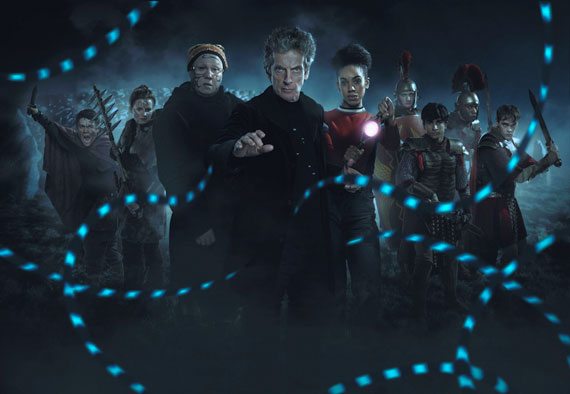
The third from last episode, The Eaters of Light, was about par for this season. We scratched out heads  wondering why aliens who ate light ran around in the darkness after human beings. Oh well... The Roman costuming was pretty good and the scenery of "Scotland" a nice change of pace. Definitely ranks with the mediocre episodes for the sheer amount of plot bunnies, but not totally a write-off with the good SFX. With some rewriting, it might have actually worked.

Then we come to the two-parter, The World Enough and Time, followed by the aptly named The Doctor Falls. Perhaps these two episodes should be collectively titled, Any Chance of A Coherent Storyline Falls Apart as the Doctor definitely "falls" into a big pile of steaming you-know-what.


The science part of the science fiction was missing in action throughout.  Bill winds up being shot and taken away  because the Doctor can't simply tell his companions to "Quick, run into the TARDIS and let's get out of here!"  (And why not take Bill into the TARDIS and take her someplace for surgery, huh?) Bill and the Doctor can't be together because there's too many floors in a space station between them, and time is happening faster at the back end than the front. This is a phenomenon noted by Einstein, but even a 500 story "building in space" wouldn't experience that much of a time dilation. It would have to be many light years in length for any noticeable effect. (Oops, that bothersome science of physics rears its ugly head again.) And finally, you take along your "prisoner" Missy out on a trip for what good reason, Doctor? Rehabilitation on the run?

Of course, if you live in a "building in space" you live in late 19th century houses and burn fossil fuels and blow things up all you like, never worrying about blowing a hole in the side of the space vessel thus allowing all the atmosphere to vent and be sucked into the nearby black hole. Yeah... My suspension of disbelief got so suspended that my eyes rolled into the back of my head and threatened never to roll back if I didn't watch something more intelligent within the next twenty minutes.

On the up side, the "Mondas Cybermen" were fun in their sock-puppet-with-a-lantern-0n-top way, and Nardole proved to be quite a hero and a gentleman. It was interesting to see John Simms channeling his inner Roger Delgado/Anthony Ainley as the Master again, complete with goatee beard, but the logic of how he came to be on the space station and why he'd help build Cybermen in the first place eluded us. (Didn't John Simms' Master end up being burned on a pyre after his Harold Saxon election-scheme fell through? It was confusing enough as to how he wound up as Missy, but logic doesn't seem to be necessary--or wanted--in a Moffat written script. Perhaps the Master faked his death then and went on to help Donald Trump's campaign?)


 The saddest thing character development-wise was how horribly the female companion was treated yet again. Correction: female companions. Both Bill Potts and Missy didn't exactly have ideal endings to their story arcs and both are made to suffer physically and emotionally first before they're dispatched. Moffat obviously wanted to do a "controversial kiss" scene in this last episode, and so he does with Bill and Heather, but it seemed tacked on and not very controversial. Bill's rescue scene is a bit of deus ex machina in implementation. We all saw that one coming, didn't we? 

It seems Moffat's idea of a happy ending for female companions is to 1.) Kill them and/or 2.) Regenerate them into an alien (or into a walking zombie in Clara's case). Either way, the girls never get to return home. Obviously, he feels women characters have to be punished by exile from Earth. Ow. He isn't making any brownie points with feminists once again.

The Doctor's "fall" isn't so much a classic Disney-death-by-falling as much as a fall-on-your-back-in-a-big-explosion (after doing terribly stupid and heroic hand-to-hand combat with Cybermen in a holographic meadow inside a space station, no less) fall. At least the Doctor is going out in a noble fashion, trying to save others by fighting the bad guys. But Moffat doesn't know when to stop there, and so we have a repeat of David Tennant's  Tenth Doctor's "I don't want to go!" whiny regeneration started. We'll have to wait until Christmas to see how whiny and clingy to Peter Capaldi's gorgeous body the Twelfth Doctor will be. Thank goodness it looks like it's going to be a "Two Doctors" special with a return of David Bradley as the First Doctor. 

Until Christmas, we'll be holding our breaths and crossing our fingers for a decent final send off for Peter. I'll be asking Santa that it be a story written by either Mark Gatiss or Jamie Mathieson. Please?

What do you think of these last episodes of the Peter's final year as the Doctor? Write your comments in below.

P.S. I'm looking forward to next month when my novel Loving Who will be released by Devine Destinies Books. (The female companion experiences a happily ever after ending, too!)


Monday, June 12, 2017

The Doctor As Show Man and Space 1889 Cosplayer


The Doctor As Show Man and Space 1889 Cosplayer
(Spoiler Alert!)

It's been a busy two weeks, so when I finally sat down to catch up with Doctor Who, I had two episodes to watch. The first episode, The Lie of the Land, is actually part three of the two previous episodes which I found to be mediocre as best. 

Was I expecting anything better for this storyline's finale? No, not really. The Lie of the Land didn't disappoint on that respect. It was mediocre in script and well-done in acting and execution. Bill is still a strong, sympathetic character willing to lay down her life to save others, Nardole is still a loyal aide-de-camp willing to go the extra mile to help out, and the Doctor is... Well, he's a show man of sorts, selling the evil monks' "new history" to the unsuspecting public through slick commercials. Why the evil monks ever go to the extent they do to take over the world is never satisfactorily explained, including the gigantic statues of their mummy-like visages. They should have taken a lesson from the Daleks and Cybermen. Good ol' fashioned firepower and metal suits work just fine to invade Earth in Doctor Who.
Missy is seen once again in The Lie, but her cameo doesn't seem particularly necessary to the plot, as the Doctor should be able to figure things out himself with his abilities and resources. She's incarcerated in a TARDIS-styled vault and seems content to be locked up. There's hints she's not as sociopathic/psychopathic as she once was, but she's still not portrayed as a positive middle-aged female image, but rather as a figure of ridicule/hate. Actress Michelle Gomez could do better and deserves a stronger role.
 
The Orwellian overtones of "He who owns the past owns the future" are good in The Lie, but the overall arc of the trilogy of episodes isn't quite pulled off.  A good script editor could have helped cobble these three disparate episodes together in a more coherent and effective manner and brought out the strengths in each. As is... nice try, but it's very sad how this trilogy falls flat. At least Bill has a decent hairstyle this time out, and I enjoyed the "Maoist China" style of bland/uni-colored clothing of the populace as well as the Doctor's "worn" jacket.

Empress of Mars is a stronger episode in that it doesn't try to be anything it isn't.  The Doctor meets his old foes, the Ice Warriors. They've been updated a bit without losing their lovable "monster of the week" look about them that they've sported since the Patrick Troughton era. My husband was pleased to see the Victorian-era military men on an expedition on Mars, very reminiscent of the characters one takes on in the role playing game Space 1889. (The military costuming was accurate historically according to hubby who is an expert on such things, too.)

Why there is oxygen underground on Mars is never explained, especially since the surface is dead and there's no obvious plant life left.  The frozen/hibernating Ice Warriors are very similar to the Patrick Troughton series Cybermen who were hibernating on Mondas in a pyramid-like set-up. 

Hmm... Pyramids and spacesuits seem to be returning images in this season, as the Doctor and Bill have been seen in spacesuits in Empress of Mars, Oxygen and in underwater diving suits in Thin Ice. The evil monks have a spacecraft (I assume that's what it is since it "flies") that's pyramid-shaped in Nemesis, The Pyramid at the End of the World,  and The Lie of the Land. Is there some kind of connection we're suppose to make with the reoccurring imagery? I have to say, Peter looks great in a form-hugging spacesuit. I hope the hoodie look has been put to rest for good.

With only a few more episodes to go in Peter Capaldi's last year as the Doctor, fingers crossed we get another Mark Gatiss-written story. What's your take on these last episodes? Please write your comments below. Thanks.
 Can't get enough of the man in the spacesuit, can you? :)

Coming Soon... The Loving Who series from Devine Destinies Books!

Sunday, May 28, 2017

The Doctor as U.N. President


Doctor Who Extremis Photo Gallery 
The Doctor as 
(Possibly Unsuccessful) 
U.N. President
(Attn: Spoiler Alert) 
 
When does a television show "jump the shark" and become a sad parody of itself? Is it possible "to unjump the shark" and redeem itself ever? That's the question playing through my mind after watching the second part of a two-parter storyline, beginning with Extremis and ending with The Pyramid at the End of the World
 
Perhaps the question is more along the lines of "Has Doctor Who finally given up on being original, fresh or even half-way intelligent and instead gone for the bleeding obvious?" The wonderful special effects, sets, costumes and mood lighting notwithstanding, it's hard press to tell you of anything of the actual plots of these two episodes, simply because there's not much of any actual plot. It seems to be a series of well-photographed scenes with little true emotional connection between them. One if left scratching his/her head and saying, "What was all the fuss about then?"

The stakes are high since Missy is back--or is she? The stakes are high because the Doctor is still blind after saving Bill--or is he, since he has those groovy sunglasses? Sometimes he seems able to see just about everything he needs to in a scene, and then in the dramatic moment in The Pyramid he can't seem to see the combo lock on the door. Even those with just the basics in fiction writing can understand why such contradictory plot points make for an unsatisfying resolution.

Doctor Who wallpaper titled Doctor Who - Episode 10.07 - The Pyramid at the End of the World - Promo Pics
 
The "monks" (which seems to be a common term for most DW alien/baddies in recent years) are predictably ugly, evil and controlling with their Matrix-like program of optical wires that is running a simulation of all life on earth. (Where have we heard something like that before? Oh, yeah, in the Matrix movie trilogy!) The Doctor and others find out about the program by reading a dark magic book called the "Veritas", eerily similar to this season's Marvel's Agents of S.H.I.E.L.D. "Darkhold" book of evil spells and power. So, the world is all fake and we're being watched by aliens--what's new about that even in the Whovian universe?
 
After the build up of Extremis, we were really looking for a satisfying ending and a tying up of strings, but The Pyramid didn't deliver on any promises. It sticks us back in "reality" (out of the Matrix) and sticks a pyramid in the middle of Central Asia where three great military powers are standing off, but no warfare ensues. Cool SFX of landing a B-52-like a Harrier jet, but that's about it. The end of the world is coming we're told, but not by falling nukes or the tiny hands of Donald Trump it seems.
 
A separate story line gradually develops, and we're told the great disaster  to end all life in the world is because of a Monsanto-clone and its evil GMO and biochemical meddling. (That made me smile actually since it's more than likely will be the case.) Generals die because their "consent is not sincere" enough for the evil monk-aliens to stop this from happening somehow. Only the true-hearted Bill can give consent because of her love of the Doctor and concern for his safety. Earth is or isn't safe at the end, but who really cares? The Doctor can see again.

I guess it helps if one is blind to the possibilities of science fiction and to the great acting abilities of Peter Capaldi and company to think these two stories were anything more than mediocre. Peter and the entire cast and crew deserved better scripts. After trying so hard to keep an open mind about Steven Moffat's scriptwriting ability this season, he's done it again in my opinion--butted into the show mid-season and put in the two weakest episodes so far. If I were the showrunner, I'd fire him. 
 
Oh, yeah, he's not about to do that, is he? On to next week and hopefully a much stronger story. It wouldn't take much to top this last pair.

What do you think? Too harsh or not harsh enough on Moffat's latest escapade? Leave your comments below.

P.S. I have a tentative release date of August for my novel of fan-filmaking gone wild, Loving Who. Yeah! Something to look forward to in the Who universe!


Thursday, May 18, 2017

The Doctor as Labor Leader

 
The Doctor as Labor Leader
(Attn: Spoiler Alert!)

We're just back from Marcon 52 and trying hard to catch up with things, so this week's review wasn't the first thing on my to-do list. I put off watching the latest Doctor Who episode for a few days (so I could make myself finish several projects first), and now I wish I hadn't. 

I find it amazing how my "day job" of being the editor of Our Revolution Continues dovetailed nicely into this week's episode, Oxygen. Both blogs are on the topics of worker/employer -- or more accurately slave/master-- relationships. To see what I mean, check out my piece at the O.R.C. blog, How to Build a Better Slave, er Worker. The fact that most human beings don't recognize how they're being manipulated and used by the oligarchy isn't a new concept, but seeing it portrayed in an effectively sinister way on Doctor Who really surprised me. Kudos to writer Jamie Mathieson, known for penning the better scripts in Peter Capaldi's first season, for once again writing a worthy episode for Peter's Doctor.

 Oxygen is quite a unique screenplay. The overt theme of the story is particularly intriguing, considering the accusations the BBC head  made thirty years ago against the producers of Doctor Who for  putting on a "leftist show." It got the show cancelled, so is this "leftist bent" made during the Theresa May leadership going to result in the same thing, or is the Beeb more interested in ratings rather than politics this time around? I think they're in it for the money, so a story theme about how human life is cheap and easily disposed of by those with the power and wealth is even more poignant.


But it wasn't all just politics--the "spacesuit zombies" were pretty creepy. You don't expect something that's supposed to protect you like a spacesuit to try and kill you. Nice touch linking the capitalists' greed to overtly killing their workers/slaves. At least the worker/slaves at the Chasm Forge understood they had a limited supply of oxygen, but they expected their masters to provide more. Too bad, so sad their corporate masters felt the workers weren't worth giving the "benefits of breathing."

There was definitely more "meat" to the plot this time out, and more Nardole as well. I've been wondering if Matt Lucas was going to get more lines, and this story featured him well. He's a loyal and conscientious companion, and he's trying to keep the Doctor on task--which we all know isn't an easy thing to do. How Nardole as a character will develop in subsequent episodes intrigues me and will keep me watching.


Bill in this episode plays the innocent in space, trusting that the Doctor and a spacesuit will protect her from the evil of the "zombies" and the faceless corporate oligarchs. The Doctor risking his own sight to save her--and then seemingly risking her life to save her again later--was quite dramatic. It's great to see Peter Capaldi playing a heroic Doctor who is willing to lay down his own life/health for the safety of his companion without hesitation. We've had enough of the "darkness" Steven Moffat tried to infuse into the first two seasons of Peter's tenure. 
 
Let the Doctor be a hero and his companions worthy aides in his fight to save humanity against the evils in the universe. Please, Doctor, come to Earth and be our labor leader! Save us from the blind greed of our corporate masters who take and take from the working poor to fill their bloated off-shore bank accounts!

What do you think of Peter Capaldi's Doctor and  the episodes so far? Leave your comments below.


P.S. It's sometimes uncanny how you can predict the future, even if you're not a Time Lord... While I was doing some edit work on my upcoming re-release of  Leaving Who, I realized I'd coin the term "The Mistress" many years before Steven Moffat had. Maybe I time traveled and didn't realize it?

Monday, January 16, 2017

Sherlock: This is The End?


Sherlock: This is The End?
(Caution: Spoilers)

I thought I'd write a quick review of Sherlock: The Final Problem since my Doctor Who reviews get quite a few reads. I have enjoyed this mystery series loosely based on Sir Arthur Conan Doyle's stories over all, but this last (and it seems to be the very last) episode was quite a let down on many levels.

I realize that the leads, Benedict Cumberbatch and Martin Freeman, are very busy actors and very much in demand these days, but it's not that fact which was a let down for me. It was the fact that, since this was probably the very last episode for the duo as Holmes and Watson, it should have been of higher quality to match their terrific performances over the years.

What to really say about The Final Problem? It was simply... a problem for me. It didn't come across as a mystery worthy of the great detective, but a gimmicky, cheap shot at trying to hook an audience with gratuitous violence and silliness. Previous episodes were based on the classic Sherlock Holmes short stories or novellas, and they seemed to work fine with their 21st century twists. This time, there was none of the charm of Conan Doyle's original characters coming through in the writing. 

Instead, we were presented with the portrait of an adult female with mental illness that was less than flattering. Somehow she is Sherlock's older sister that he never knew he had, which, of course, is not canon. Misogynistic portrayals of women characters is a problem area for producer/co-writer Steven Moffat.  It has been written about by yours truly (see my Doctor Who reviews from a year or so back) as well several other feminists. 

Why Mr. Moffat comes across as "tone deaf" when it comes to writing female characters is a mystery in itself, but it is a consistent problem he has in most of his scripts. He views women as objects to be used to further plots, but they have few, if any, positive characteristics. Psychopathic and sadistic Euros is the winner of  "The Universe's Worst Woman of All Times Award." She has absolutely no redeeming qualities whatsoever. (Correction: My husband reminded me Euros is an excellent violin player. She does have one redeeming quality.)

Other female characters aren't depicted much better in this script. Poor Molly, who has had a crush on Sherlock all these years, is shamed by Euros's trickery and made to feel bad about her love for Sherlock. He, in turn, is ashamed of his affection towards her. How "unromantic" and "un-gallant" is that?

Shooting and drowning unarmed and tied-up hostages is Euros's idea of fun. She's supposed to be related by blood to Sherlock, Mycroft and their seemingly very gentle parents? (I guess the violin playing ability demonstrates the shared genetics?)  If we had never met Sherlock's parents before in a Christmas story and seen them as "human," maybe we could have believed they spawned a she-demon in Euros. But we have seen their parents, and they came across as "normal." So, there's no real satisfactory explanation of how Euros's psychosis came about and why Sherlock and Mycroft are not also insane. 

Five year olds don't usually become "The Bad Seed" all on their own. It takes quite a lot to drive any person to those types of behaviors. Children who are physically, mentally and sexually abused over and over again can suffer a mental break down and act out violently. Are Moffat and Gatiss in their co-authored tale implying all three of the Holmes children had a horrific and abusive childhood?

Yes, it's a real let down of a story. To be fair, I'm looking at it as a professional writer and a person with a psychology degree and some knowledge of what abuse can do to the individual. But honestly, there was nothing particularly uplifting, redeeming or even accurate in any of the character portrayals as written. This lack of logic in the story wasn't enjoyable.

I really do enjoy Benedict Cumberbatch's Sherlock Holmes, Martin Freeman's Dr. Watson and Mark Gatiss's Mycroft Holmes. They are superb actors. I was  looking forward to a better send-off for all three characters. Let's hope they have the time and energy to make at least one more positive and hopeful Holmes-like mystery so I can forget this episode as easily as Sherlock can forget his young friend whom Euros chained to the bottom of a well. 

(However did a five year old girl  managed this physical task is beyond my comprehension. Perhaps Mr. and Mrs. Holmes helped her dispatch and chain up the little boy, and they truly are monsters? Ugh.)


Wednesday, December 28, 2016

Doctor Who Review: The Return of Doctor Mysterio


 Doctor Who Review: The Return of Doctor Mysterio

I haven't written a TV episode review in some time, so I thought I'd dust off my reviewing skills and dive in once more with a very short critique.  

The Return of Doctor Mysterio was, on the whole, much better than I'd thought it would be. First off, it wasn't one of those "I hate Christmas!" holiday specials that Moffat seemed to enjoy writing in recent years. In fact, other than a brief allusion to the Doctor possibly being Santa Claus in the opening act, there was nothing Christmasy about the story. That's a good thing, in my opinion. It's best to stay away from a subject you don't like as a writer, especially with Steven Moffat's hang ups.

The tone of the tale was upbeat and positive throughout, and we were introduced to a pair of very likeable characters in Grant and Lucy. New York as a location was fine, although it could have been written to take place in any large city, really. Why not Chicago or Denver or Cleveland or St. Louis next time? It's nice to get out of London and the British Isles occasionally, but there are other cities in the U.S. besides New York, you know?

The evil aliens who are invading Earth this time around were very cool. Zipper heads? Replaceable brains? Aliens substituting themselves for government leaders and getting away with it at the people's expense? I find it a plausible enough premise after our recent election, so I'm all in for this sort of monster-of-the-week.

I wasn't too sure about Matt Lucas' character of Nardole in the script at first. (When did he join the Doctor and how?) But since he didn't detract from the action or the growing romance of Grant and Lucy, and brought about some genuinely funny moments, I was okay with his addition. 

The whole "superhero comes to life" humor and sub-plot was very entertaining. Who doesn't want to see "Clark Kent" woo "Lois Lane"? Who doesn't like watching a little boy fly about the skies of Manhattan in his pajamas? It was a storyline that younger family members could understand, follow and enjoy as well as us old-timers. The special effects and costuming were all superb as usual, and I loved seeing Peter wear a more classic Jon Pertwee-styled outfit with a velvet jacket minus the hoodie. Very dashing!


I hope the upcoming series keeps this episode's upbeat and positive focus, avoids the "teenage soap opera angst" of the Clara years (yawn!) and stays with emphasizing the Doctor's good traits of being hopeful and helpful to mankind. The moody, sometimes mean-spirited, Doctor didn't work well for me in the past season. I greatly prefer Peter Calpaldi's Tom Baker-like performance in The Return of Doctor Mysterio. No more endless crying over lost girlfriends--the classic era's dictum of "No hanky-panky in the TARDIS" worked much better for character and story development.

We need to see a return of strong  and intelligent female companions such as Leela, Sarah Jane, Liz Shaw and Donna Noble. It would be nice to actually like the Doctor's companions instead of cringing over them as we've done in recent years, so perhaps Grant and Lucy can make a reprise later on in the season? Nardole might even grow on me given time and decent writing.

My British husband, who gave up on Doctor Who after viewing the "Mary Poppins Master" (Missy) episodes, dared to watch this show. The verdict? He said he enjoyed it. Considering he has watched Doctor Who since the William Hartnell era, that's a good sign it has improved in quality.

What do you think of The Return of Doctor Mysterio?

Sunday, December 27, 2015

Romancing the Doctor (On New Doctor Who)


Old lovers can still be friends.

Romancing the Doctor (On New Doctor Who)

***Spoiler alert!***
One wonders why the current producers of Doctor Who feel it's necessary to do a "Christmas special" (since the Doctor isn't human nor professes to be a follower of Jesus) but every once in a while it's nice to see an episode slightly out of the ordinary. This season needed a break from the soap opera angst of the Clara story arc, so anything to take our minds off of it is a good thing.

Even my husband agreed with me on this point concerning The Husbands of River Song. Less teenage angst and lots more humor--and Alex Kingston to boot. It's nice to see an actress who's equal in charisma to Peter Capaldi playing opposite him. River Song is a fun and mischievous character who is always up to something, so the lighthearted jaunt to sell off a pilfered diamond to a race of genocidal alien one-percenters aboard a space cruise liner is just the mindless entertainment we needed.

It's not a perfect episode of course. The threat of killing River's "husband" the cyborg king with a human head and then crashing a ship full of passengers (no matter how heinous their crimes) is a downer. Fortunately, the excellent performances of and the magical chemistry between Capaldi and Kingston pretty much drown out that tinge of nastiness that always seems to be a part of a Steven Moffat script. The unneeded nastiness really could have been edited out, but this season pretty much proves script editing is not of importance to the show runners.


See? The Twelfth Doctor can smile. And it fits his face just fine.

Ah, but to stare into the handsome face of Peter Capaldi and admire the beautiful radiance of Alex Kingston on screen for an hour! Now, that's a holiday gift worth the wait.


What do you think? Please leave your comments below, and check out my reviews of earlier episodes of this season of Doctor Who:
Hell Bent 
Heaven Sent
Face the Raven  
Sleep No More
The Zygon Inversion (or Inversion of the Zygons)
The Zygon Invasion


Classic Who on Retro TV

Monday, December 07, 2015

Retconning the Doctor (on New Doctor Who)

 Retconning the Doctor


***Spoiler Alert!***

"Am I supposed to understand anything you're saying?" -- Clara in the Matrix on Gallifrey

Take all the cool and interesting things that a multitude of writers have created for Doctor Who since its inception--the Time Lords, Gallifrey, the TARDIS, time travel, the Matrix, the cloister bells, those odd cardinal-like robes and funky head/shoulder gear the bigwigs wear--toss into a big pot, forget all about series canon, and stir. Upturn pot and pour out onto the page. Ta-da! You have the season finale, Hell Bent.

Of course, since this is Moffat's Who script you have to add in his creations--Clara and Ashildr (Me)--and plenty of creepy bits of his Blinking Angels and a Dalek stuck in a haunted-house-like data collection device known as the Matrix. (Google the Tom Baker episode The Deadly Assassin to see how different the original Matrix on Gallifrey is from this new incarnation. Yeah, it's that different!) There are some funny bits tossed in as well, such as Time Lords now regenerate without much of a hangover, changing gender/age/race simultaneously. Tack on a relatively satisfactory ending after a lot of head scratching and feet dragging.  Ta-da!


This time it's the Doctor who gets the mind wipe and not the companion (see Donna Noble) so he can move on. The undead Clara gets to have some "girlfriend time" with Ashildr in their own fifties diner-shaped TARDIS with a pure-white classic interior. How either of these young ladies know how to pilot a TARDIS isn't explained. Neither is the previous "rule" given that only a Time Lord could manage a TARDIS because of their psychic link. 

Is it good to violate the TV series canon? Nah, who cares! Nobody will notice.

Even for new Whovians who haven't a clue that Leela lives somewhere on Gallifrey, this "word salad" of a script seems to be missing something vital: emotional connection. Even with a script jumping all over the place like a hyperactive kid on a Christmas candy rush, you'd think it would be able to settle down long enough for the characters to connect with their audience. But therein lies its weakness: the emotions are telegraphed for you. 


You don't have to think or feel for yourself when you're told pretty much what is going to happen up front, similar to what happened in an earlier episode this season. (See my review for Before the Flood.) You know that Clara is going to "live" again, and the Doctor is going to forget all about her since we start out in a scene at the diner where this is made painfully obvious. I suspect the current show runner feels he has to spell everything out because he believes Doctor Who's viewers have IQs to match their shoe sizes, and we all have tiny feet.

I think my husband, a long time Whovian, said it best: "The show has gone from good scripts and wobbly sets to good sets and wobbly scripts."

All the lovely photography, location shoots, costuming, special effects, musical score, etc., do not a strong story make. (Just ask George Lucas.) Not even a classic character like the Doctor can withstand all the retconning that's happened to him in the Moffat era and come out for the better. He's been diminished somehow, made into a permanent fool, a pale shadow of the strong action character he used to be. 


Peter Capaldi reminds me of Pierce Brosnan when he finally got the part of James Bond after many years. Pierce made a great Bond, but unfortunately he got stuck with the weak scripts of that period and left early. If only the great writer Robert Holmes was around to give Peter's Doctor the shot in the arm he so badly needs after this season. A great actor like Peter Capaldi deserves the best!

We have the Christmas special with River Song to look forward to in a couple of weeks, and it appears to be a comical tale. That's good. After all the forced drama and tears of the Clara years, it'll be nice to see the Doctor relax and enjoy himself a bit with a mad romp. Fingers crossed!


What do you think? Please leave your comments below, and check out my reviews of earlier episodes of this season of Doctor Who:

Heaven Sent
Face the Raven  
Sleep No More
The Zygon Inversion (or Inversion of the Zygons)
The Zygon Invasion


Classic Who on Retro TV


google-site-verification: googlec9fe367ac800d499.html