
Showing posts with label fiction writing. Show all posts

Thursday, May 09, 2019

Off To MARcon!

We're off  this weekend to see our friends at MARcon. It's been two years since we've attended the convention, so we're excited to visit and catch up.

For a "gift" for those attending the con (and anyone else who happens across this page), I thought I'd share a short short story I penned just today. I wrote it alongside some students at an after-school program where I tutored this past semester. See if you can guess what was in the photo I had for the 15 minute writing prompt. 


Belly Flop

How could I say no? To say no would have hurt Aunt Maribelle's feelings and she had already been through so much this summer what with the chemo treatment and all. So, I said yes--yes, I'd go with Uncle Jeff to that fancy pool club that his boss had given him a couple of summer passes to in reward for all of his hard work. 

Don't get me wrong. Uncle Jeff is a great guy. He's a good employee and a great husband to my mom's sister. This past year had been tough for both of them after my aunt received her cancer diagnosis. If anyone deserved a break from the stress, it was my favorite Uncle Jeff.

The thought that I might run into some of the snooty rich kids from school didn't occur to me until  we arrived at the gates to the pool club. Oh no! That cute guy who 'd been in my science class was there--and so were half the cheerleading squad and the football team. Suddenly, I felt inadequate in my hand-me-down bathing suit with my faded and ragged beach towel on my arm.

But my embarrassment over my outfit was nothing compared to the sheer horror I felt when Uncle Jeff decided he couldn't wait to get into that cool water. I forgot to tell you that Uncle Jeff is more than a great guy--hes a great big guy. He's huge with a capital H.

Also, once Uncle Jeff gets an idea into his head, there's no turning him back. He will carry through with his plan no matter what. 

"Race you to the middle," Uncle Jeff yelled above the roar of the crowd. And then he took off.  For a large person, he's surprisingly fast on his feet.

"No, wait! It's too crowded. Don't go there yet. It's full of people, Uncle Jeff! Nooo!!"

It was too late. He'd already dove into the shallow end of the pool and displaced more than half the water and terrorized more than half the pool-goers in a split second of belly flopping. My face turned redder  than a third degree sunburn.

I thought I'd never live this stunt down.

But the rest of our swim turned out better than expected. The traumatized moms and dads and kids seemed to take belly flop in stride. Soon I relaxed and enjoyed myself and forgot my embarrassment over Uncle Jeff 's enthusiastic splash.

You know, even your craziest relatives love you. They invite you to the pool. We gotta cut them some slack now and then and let them be their crazy selves. Uncle Jeff taught me that.




Friday, September 16, 2016

Meet the Authors of Olivia's Escape


 We were recently asked some questions about our writing and our methods as writers. Here are our responses:

Are you a full-out plotter? Are you a "let's see what happens" pantser? Or do you think you fall somewhere in between? Describe your process in coming up with and executing a story idea.

Adrian says: I'm by nature a pantser. I will plot things out if necessary, like when I'm writing a murder mystery. I don't really have a process in coming up with a story idea. They come to me from out of the ether--in the middle of the night sometimes--and then I write the story idea down.

Cindy says: I have to admit to being a "let's see what happens" pantser. I've tried to be more methodical and plot things out in detail, but somehow the characters always take me by the hand and lead me down another path. They just start "talking" to me as I write the scene, and they tell me they're not going to do as I want them to do. (Very much like children, it seems!) I'm not sure I have a set process for coming up with story ideas, but I read quite widely and expose myself to a lot of different people and subjects as a freelance writer/editor, so I'm constantly being inundated with potential characters and stories. Once I get a feel for "a character who has a story that needs telling" I start to envision the opening scene with my main characters and allow myself to be taken on a ride from there.


**Where is the most interesting place you have ever traveled? If you haven't traveled much, where would you absolutely love to go?

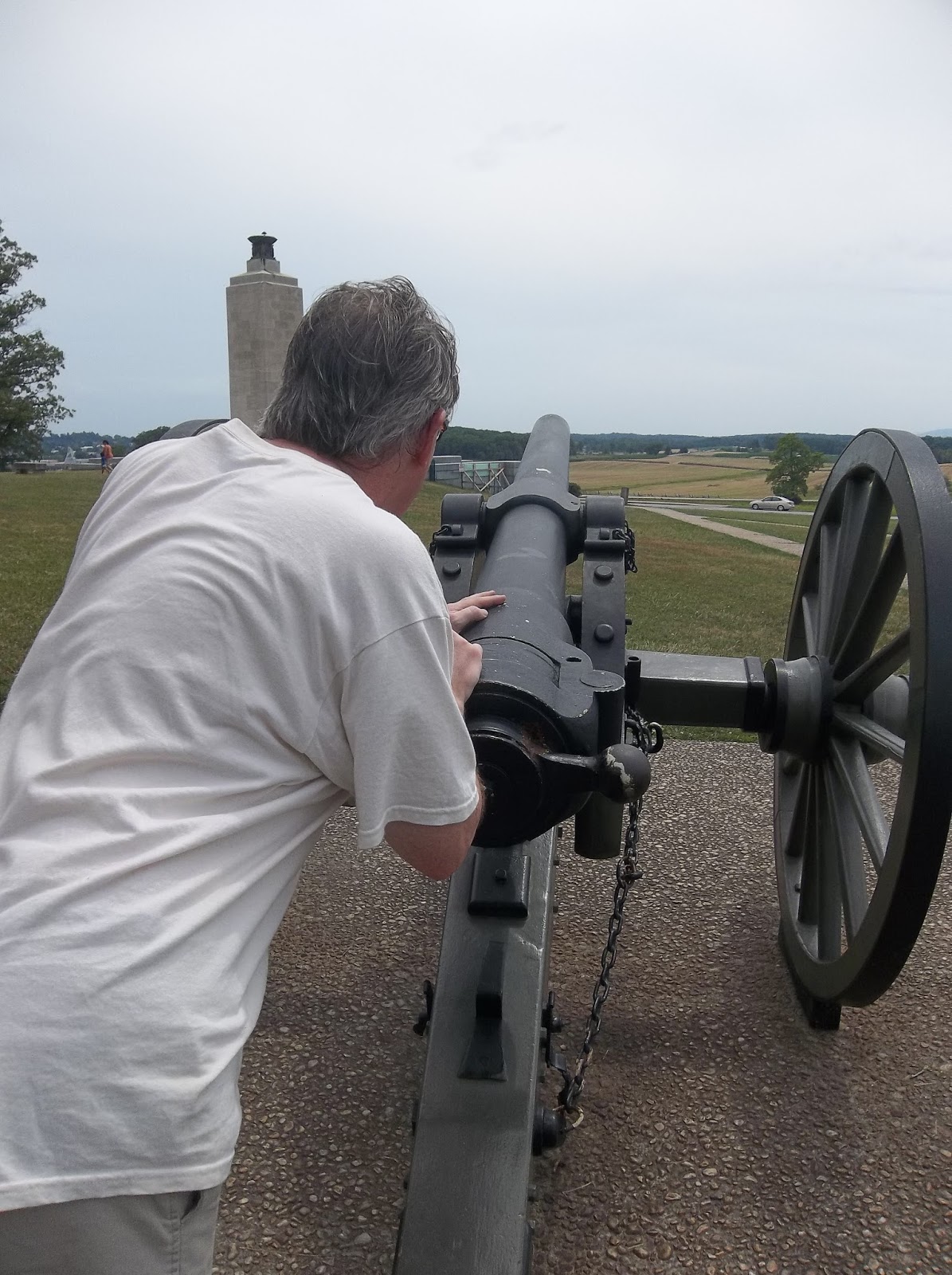
Together we've traveled to several Civil War battlefields and sites, such as

Wilson's Creek in Missouri, Lookout Mountain/Chattanooga in Tennessee and Chickamauga and Kennesaw National Battlefields in Georgia. Recently, we stopped off at both the Gettysburg and Antietam National Battlefields. (Hint: Try not to tour both of these within 48 hours--there's way too much to see at each to do them justice.) We're hoping to return to both of them someday soon and visit other Civil War sites in Virginia and West Virginia as well.

We both used to do French and Indian War re-enactments, so we really enjoy touring historical places and speaking with others about the significance of what happened there and the historical personalities involved. When we were in England visiting Adrian's family, we enjoyed touring castles and other historical sites in County Norfolk.


**What have you never written about, but want to some day?

Adrian: I've had the idea for a SF story knocking around for years, but haven't got around to writing it beyond working up a few notes.

Cindy: I've always wanted to write a more "hard science fiction" novel about a near future that may or may not come about and the consequences of our actions in bringing such a world into existence. I'm not saying it would be Orwellian in tone, but it probably would be much more "serious" than anything I've been able to publish so far (in fiction at least).

**Describe for us how it felt the first time you actually completed a manuscript.

Adrian: Jubilant! There's nothing better for me as a writer than the moment when I type "The End."

Cindy: I think I was shocked the first time I completed a romantic-comedy novel. It had taken some time to write that first draft (as I had two very young daughters underfoot at the time) and my first thought was, "What do I do now?" Luckily, I joined a writer's group not too long after finishing that book, and I learned a lot about rewriting and polishing a manuscript for publication, so much so that I eventually sold the book, The Fixer-Uppers. (And it is still in print/e-print, too. You can read about it at my contemporary/fantasy romance persona's website www.cynthianna.com.) 


**Did you write stories or make up stories as a child? Do you remember what any of them were about? Tell us...

Adrian says: I did write a short story at age 8 or 9. It was about the pilot of a 1930's Grumman Goose seaplane who discovers pirate treasure in the South Seas. I can even remember the title - "Barry Linton's Treasure." I might just revisit the idea as a full YA novel one of these days, although the 80's TV series "Tales of the Gold Monkey" seems to have stolen my idea!

Cindy says: Oh, did I ever make up stories when I was a child! I remember my mother helped me write my first "picture book," which was a story about a dining table full of talking objects who came to life late at night… 


The salt and pepper shakers were characters, as was the butter in the butter dish and the sugar bowl, etc. I drew the pictures in blue ball-point, as I recall, on scrap paper, and my mom wrote the words of my story beside the pictures and bound the pages all together, and I then made proper cover for it. (I was about four or five years old, and we didn't learn to write until first grade way back when. We didn't even have to attend kindergarten!) 

I hope I can find the remnants of my first "book" someday in all the boxes of nostalgia I've inherited from my late mother, but I fear it's long been lost. Still, I am ever so proud to say I "wrote and illustrated" my own book before I even attended school.


**Consider the main character in the last book you had published with DBP. What was different or special about him or her?

Olivia is different from a lot of our other heroines because she's 1) a young adult (age 17 in the first book) and not a mature adult (as we both usually are drawn to write), and 2) she's a strong person who acts on the courage of her convictions. 


That's not say Olivia is a person without self-doubts--because all of us question our own motives from time to time--but Olivia is special in that she has the innocence of her childhood and the love of her family fresh in her mind when she faces the challenges of being abducted and taken to an alien world. Her bravery is genuine and not jaded by a long past that many older characters have. In other words, she hasn't grown overly cynical. 

Olivia feels free to take a moral stand and to do whatever is necessary to bring about change on BloodDark to help her new friends and her new love, Hernando, survive and thrive there. It's quite refreshing to write from the perspective of a young and positive heroine who has the energy and guts to tackle challenges without shying away from them.

**Do you have a favorite inspirational quote/scripture/poem that you feel motivates you?

Adrian:
I like this quote:
"We are all of us lying in the gutter, but some of us are looking at the stars." --Oscar Wilde

Cindy: My favorite poem is "Success" by Ralph Waldo Emerson. Its last stanza is particularly motivating:

"To know even one life has breathed easier because you have lived.
This is to have succeeded."


Be sure to check out our latest release, Olivia's Escape, from Desert Breeze Publishing!


Wednesday, April 08, 2015

Crafting Great Story Openings (Story Hooks)


Overwhelming.


If most people could sum up their typical day in one word, overwhelming might be at the top of the list.


Think about your typical day. You have places to go, people to see, bills to pay, children to feed, spouses to listen to, bosses to deal with, appointments to make, and other unexpected diversions (some pleasant and some not-so-pleasant) coming at you from all sides. You really could use a break to relax and unwind, but it’s got to be a quick one because you don’t have much time. You have things to do!


What does the mad pace and constant rush of our current culture got to do with writing fiction? To put it succinctly—everything. A writer doesn’t have much time to get the twenty-first century reader hooked into a story before the reader realizes he/she has a million other things to do and puts the book (or Kindle) down to go tackle the to-do list. If you want to entice readers to pick up your book and keep turning pages—even when the kids are yelling for supper—then you’ve got to create a strong interest in your story and characters quickly using a bare minimum of words.


“But wait,” I hear some of you saying. “I have to tell the reader all about this wonderful world I’ve created first. I have to tell them about the planet’s terrain and the weather conditions, and the fantastic hairstyles they all have, and how the price of coffee affects who they vote for to become their supreme dictator…” 


I have just one word of advice about this sort of thing: Don’t.


The opening lines and pages of a story have one purpose only—to grab readers by the heartstrings and make them care about a character and the circumstances this character finds himself or herself in. If you’re using the opening pages to describe the weather, how are readers supposed to come to care for your character and his/her story? The reader wants to connect immediately with a character and experience his/her pain, joy, fear, or anxiety. The details of the setting can wait. Get us cheering for a character first.


One of the best ways to hook a reader is by starting in the middle of a scene that illustrates the character’s “journey”—a physical and/or emotional journey. In other words, the character from the very first line is about to take an action or make a decision that will change the course of his/her life. It can be as big as saving an entire star system or it can be more intimate like deciding whether or not to go on a blind date (the premise of one of my novels). Whatever the action, don’t start at the “absolute beginning” and list all the minute details, but rather start somewhere in the middle of the scene closer to the point when the character makes the decision that will propels him or her on a journey. 
 
What's missing from this pretty picture? Maybe it's a "who"? 
You need a character in your opening scene, not just scenery.

Let’s say your heroine has already decided to go on the blind date. The first scene could show her getting ready for the hero to arrive at her front door, and he’s more than an hour late. Think emotions. What is going through her head right now? Fear? Boredom? Frustration? Did he back out at the last minute? Was he killed in a car accident? There are many emotions your heroine could be feeling, so choose one and start with it. Here’s the first line I’d go with:


“Some blind date he is—how dare he keep me waiting!” 


There’s a hint of frustration there, isn’t there? And possibly a little fear or worry. But as you can tell, I didn’t describe what my heroine is wearing or how she fixed her hair or even give her name. All those things can wait. The first line doesn’t need details—it needs to help your reader identify with a character and feel his/her emotions as if they were the reader’s own. If you’ve ever felt stood up while waiting for your date to arrive, I bet you can relate.


My next paragraph might be:


Rachel stomped her foot and growled at the back of her front door. It had been at least six weeks since her co-worker caught her in the break room crying over Billy dumping her. Why had she allowed Maddie to set her up on this stupid blind date with her bumpkin cousin who didn’t seem to own a watch? Did she really seem all that desperate?  On Monday morning, Rachel vowed to give Maddie a piece of her mind!


You’ll notice that a first scene doesn’t need to tell the reader tons of background information. By showing the reader what is happening in the hearts and minds of your characters, the back story will come through. Keep in mind that fiction writers aren’t “storytellers”. In reality, writers are “story show-ers”.  If you show your characters living their lives through their words and actions, you will never need to tell how they feel or bore readers with dry details. Your readers will experience your story through the character’s emotions and reactions to the situation. Your readers will live the scene through your characters…


And then you’ll have hooked them into your fictional world and the fascinating characters who inhabit it and the relationships they experience. The soup may boil over and the boss may keep texting, but your readers won’t want to put your book down because they have been caught up in a whirlwind of emotions and feel as if they’ve truly come alive inside your story. Now, that’s a great hook.


For more easy-to-follow tips on how to impress an editor and get your manuscript published,  read Defeating the Slushpile Monster.
 
Available for the Kindle at http://tinyurl.com/kindleSlushpile and in print at http://tinyurl.com/slushpile

If you're looking for a freelance editor, send me an email with the subject line of "Editorial Services" at cynthianna@hotmail.com  


P.S. If you get a chance to review any of my books, thank you. I appreciate you taking time out of your busy day to leave me your opinion, good or bad. If you do a review, send me your email address and the link to the review so you can be entered into a special drawing. I promise the giveaway will be an exclusive for readers like you.

P.P.S. It's not too late to sign up to the Triple C Newsletter (sign up box on the right side bar). Subscribers will receive a free ebook!
google-site-verification: googlec9fe367ac800d499.html