Showing posts with label historic re-enactments. Show all posts

Sunday, October 18, 2015

The Story That Tried (on New Doctor Who)


The Story That Tried
***Spoiler Alert!***

Hey, Vikings! It's been fifty years since we last seen them on Doctor Who, so Jamie Mathieson's script idea was a welcome breath of fresh air we thought. We loved his last season's scripts for Mummy on the Orient Express and Flatline, both which are possibly the best written episodes in several years. Then we caught the co-writer's name--Steven Moffat, the show's producer who seemingly feels compelled to write or re-write every episode. Oh, well... maybe Jamie's magic will outshine any alterations Mr. Moffat makes to the story?

When people write together as a professional writing team, the reader/viewer usually can't tell where one author starts writing and then stops and his or her partner begins writing. (For instance, my husband and I just recently sold a jointly-authored Y.A. sci-fi novel series--more news to come!) Alas, there were several things that jumped off the screen in The Girl Who Died that just didn't seem to mesh as well with the overall writing-style. I suppose these rough bits were Moffat's additions? The first thing that really jarred was the title itself. Like last week's introductory scene, where the Doctor explains the entire story premise upfront, the title sort of gave away the "big secret" that a girl was going to die. Since it probably wasn't going to be the companion character, that left Ashildr, the Viking girl who helps the Doctor and Clara. Talk about killing all the mystery and tension!

The Vikings had a lovely village set, and it was great to see the Doctor materialize in another place rather than contemporary London or Wales again. Since the Vikings ruled an area from North America to Russia and south to Turkey, the village could have been anywhere within their realm. However, one thing jumped out that shouldn't have been there: the horns on the helmets. 


According to my daughter, who attended graduate school in archaeology at the University of Southern Denmark and is a professional Viking re-enactor in Europe, Vikings warriors never wore helmets with those big longhorns on the top. That's a fallacy perpetually kept alive by Bugs Bunny's famous What's Opera, Doc? and Asterix and Obelix comic strips. Take it from me, they just didn't, and my daughter can provide the historic proof to back it up. Also, the modern belt buckle I spotted on Ashildr's costume (why was she wearing pants and not skirts like Viking women usually did?) wasn't found in that time period, either. Vikings used beautifully forged decorative pins to hold their clothes together in the places that weren't tied or sewn together. One would hope the BBC costume department had enough of a budget to call an expert in Viking clothing to double-check these things, but perhaps Mr. Moffat thought such anachronisms funny?

The "Mire" villains reminded us of Sontarans or the Judoon from previous seasons. "Odin" looked like the pirate captain in the Douglas Adams' script The Pirate Planet in the Key to Time series during the Tom Baker years, too. The Doctor's odd nasty remark that "God never makes an appearance" (like he does in Monty Python and the Holy Grail) to explain the appearance of the aliens to the Viking villagers sounded more like an atheist's complaint than something the character of the Doctor would say, as he generally respects other cultures. Once again, it sounded like an addition made by another writer with an ax to grind--Mr. Moffat, by chance?

Peter Capaldi seemed to be channeling bits of Tom Baker--along with Patrick Troughton and Jon Pertwee--in his performance. His Troughton-like plaid trousers looked a bit out of place with his "'90s grunge band look" hoodie and t-shirt under the jacket. Last year's more sophisticated style of dressing seemed to suit him better than the uber-casual teenage boy look he's sporting this season. 

The Doctor's more warmhearted approach (he actually hugs Clara without prompting) is a nice touch this time out, but his unusual decision to re-animate "the girl who died" seemed completely out of character for him. The Doctor usually insists that the time line shouldn't be altered for anyone and that death is final.  (If it isn't, why has he not gone back to save his companion Adric who died during his fifth incarnation?) One suspects neither the girl's death nor her resurrection was included in the original story idea Mr. Mathieson pitched, and that it was added to give a guest appearance slot to Maisie Williams for two episodes as a ratings gimmick. 


The "reason" for the Doctor changing his mind about bringing her back to life came across as an weak attempt to appease fans.  Some must be dying to know why the Doctor looks very much like the Roman father from the 2008 Fires of Pompeii episode, but it seemed contrived. After all, Colin Baker appeared in the fifth Doctor episode Arc of Infinity as Maxil, a Gallifreyan guard, and we were never given an explanation for why the sixth Doctor had Maxil's face, and the audience handled it just fine. Yet another example of an alteration made to Mathieson's original script?


We're given hints that poor Ashildr is now immortal, and she's going to hate it and go insane since she will outlive all her loved ones. It makes sense, but then again, Captain Jack Harkness is also an immortal Doctor Who character who hasn't gone insane, and he's outlived everyone and died horribly numerous times to boot. (He just keeps coming back no matter how many little pieces he's pulverized into, poor man!) Why is Ashildr different? And does this mean that Jack has a chance to come back on the show to help a fellow immortal cope with the meaning of her existence? Captain Jack fans are anxious to know!

Over all, The Girl Who Died seemed like one long set-up for its second part/sequel next week. If some of the "additions" to the script had been left out, and the story focused more on the Doctor and the other characters, perhaps it would have been stronger. So far this season's writing hasn't lived up to the quality of  last season's non-Moffat written episodes--not including the dreadful Moon/Dragon's Egg "worse episode ever" as it's been called. (We suspected it had been written by Moffat as well.) If Jamie Mathieson is allowed to write for Doctor Who without a "co-writer" tampering with his story ideas, perhaps the writing will improve. 

Or not. Let's hope they keep trying.


What do you think? Please leave your comments below. And check out my reviews of earlier episodes of this season of Doctor Who:

Sunday, August 01, 2010

Hot Time in the City

Hot time! Summer in the city--back of my neck gettin' hot and gritty!

Yeah, it's summer, it's sweltering, and my melted brain has resorted to quoting (badly I might add) lyrics from a classic top 40 hit. It can't get much worse than this, huh?

Well, all hasn't been that bad this summer. The handsome man and I celebrated our first wedding anniversary on July 3rd. Yipee!! We still haven't killed each other (yet) in spite of the heat. The honeymoon keeps going on and on.


Revisiting the scene of the crime--er, our wedding in the park gazebo!

And we've done a bit of "time-traveling" again at a regional historical re-enactment. Here are some photos from the first ever "Muster at Forest Glen". It was held at a very lovely park near Danville, Illinois, and a good contingent of French and Indian War re-enactors showed up (in spite of the horrible heat and humidity) and some of the public did as well, too.


Discussing topics of high importance--like how to avoid the French field surgeon who'd bleed you to death!


Drilling before the battle.


You try smiling in the heat in all these layers. Our ancestors were first-rate masochists!


Big cannon goes KA-BOOM!


Diana demonstrates the art of spinning to eager young minds.


Adrian hits the bullseye with his tomahawk throw. Don't mess with him, Frenchpersons!


The British contingent at colors.


As soon as it cools down here, I promise to write something more coherent. In the meantime, all we can do is sit and fan ourselves silly... There's really nothing else one can do when it's 110 degrees in the shade, is there?

Tuesday, September 22, 2009

Voyages Around the Time Line!


Yes, it’s been a while since I’ve posted a blog, but I really have a good excuse this month. I’ve been traveling around the timeline.... Literally! No kidding. I even have some photos to prove it.


Before I forget, I’ll be traveling into the future the weekend of October 2-4 to Archon, a science-fiction convention in Collinsville, Illinois. I always enjoy meeting readers, fans and other interesting people at Archon, so be sure to drop in on one of the panels I’ll be on and introduce yourself. I hope to have some copies of my fantasy-screwball comedy, time-traveling novel, LOVING WHO, with me to sign and sell. (Keep your fingers crossed the publisher gets them to me in time.)


Other time periods I’ve experienced this past month include the pre-Civil War period in the “northernmost Confederate-sympathizing city” of Hannibal, Missouri. My husband, Adrian, and I even met and shook hands with Mark Twain “himself”. He’s looking great for his age. What a witty man—marvelously entertaining! Other sites of interest in the Hannibal area included eating at Lulabelle’s, a former bordello (it was in operation up until the 1950s) and touring not one, but two caves. Check out Hannibal for scenic views of the Mississippi and small town life as it was not so many decades ago.


During Labor Day weekend, we visited two historic forts across the Mississippi—Fort De Chatres and Fort Kaskaskia. The first is a French fort built in the early 18th century that was eventually demolished by the British after the French and Indian War. It is partially reconstructed and stands as a testament to a long ago time when other powers ruled this part of the world. Just a few miles down the road stands the remains of Fort Kaskaskia, where Lewis and Clark recruited a dozen men to go on their Voyage of Discovery in 1804. The cemetery of the lost city of Kaskaskia lies nearby, a testament to the power of the river to completely wipe out Illinois’ first capital city in the later half of the 19th century.


From the pre-Civil War period/early colonial era, we jumped back to the late 17th/early 18th century and the Spanish Main as we traveled to the St. Louis Pirate Fest up in Wentzville, Missouri. Yo-ho-ho and a nice pickled egg, me mateys! Pirate Fest has lots of fun entertainment from guys in short pants and more earrings than a jewelry store along with great music groups, such as "3 Pints Gone" and "Queen’s Gambit". We enjoyed food like “bangers and mash” and “jugged fish” while watching the pirates duke it out with the “French” of “Port Royal”. A family-friendly event, Pirate Fest is the last three weekends in September each year. Plan to come aboard!


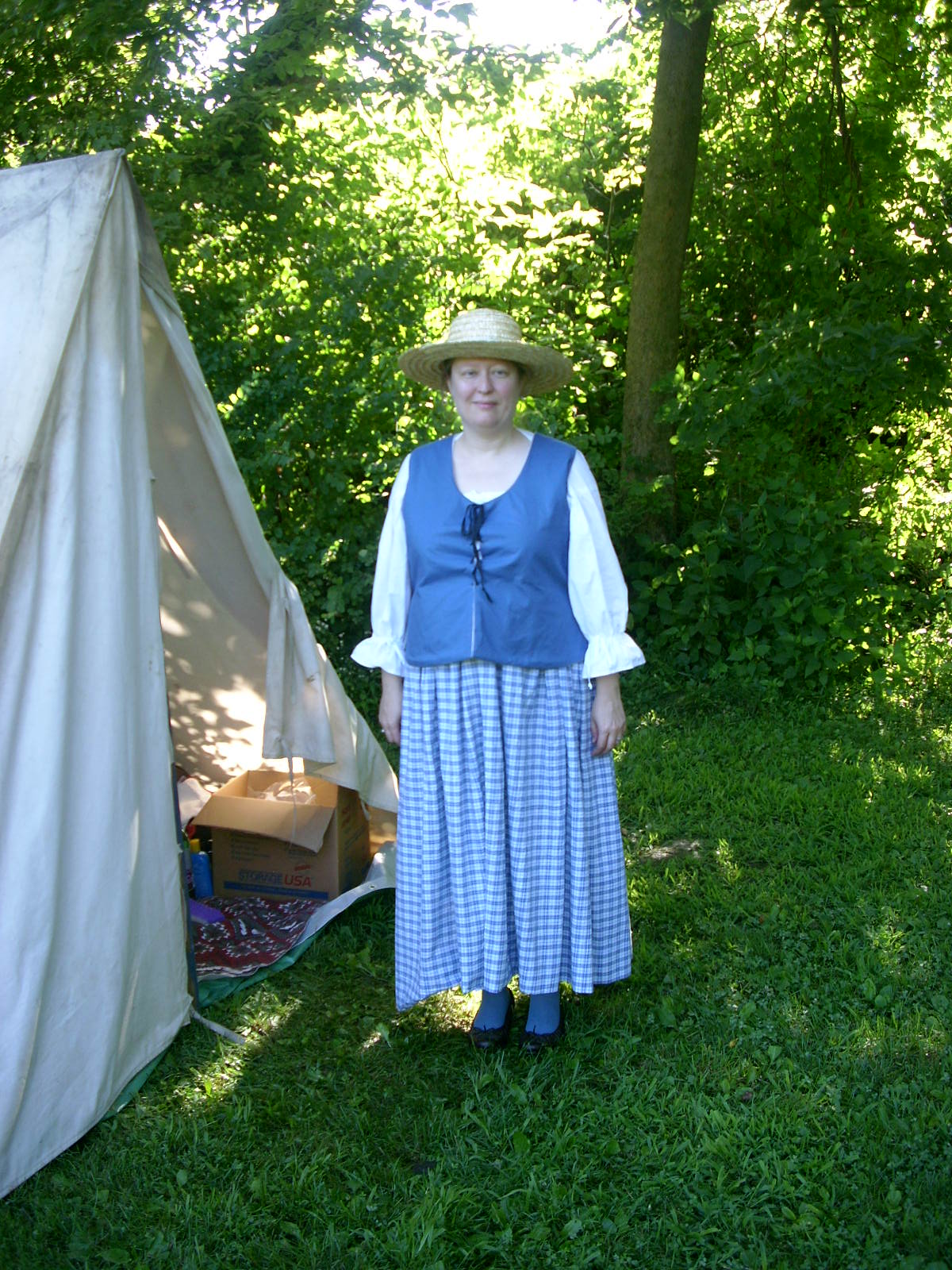
We hovered around the 18th century and then plunged the next weekend into the 1750s to experience the intense drama of the French and Indian War at Koh-koh-mah, a historic reenactment near Kokomo, Indiana. Primitive camping with plenty of wood smoke permeating your clothes and hair--ah! It was enjoyable weekend in spite of the fact there were no showers or flush toilets. But, hey! This is 250 years ago… You just put on more layers of clothes to cover your funk. I enjoyed wearing long skirts up until Sunday afternoon when a short rain shower broke, drenching the reenacting field and muddying the hem of my nice gown.


But there’s no crying in reenactment—there’s just mud and dust and grime and smoke and lots of fun discussing the lifestyle of the French, British and Native Americans of the era. Adrian had a great time portraying a 78th Frasier Highlander shooting his musket at those pesky French persons who tried to take over the fictional fort. In the end, the British prevailed. (Historically speaking, twenty years down the road, these very same Frasier Highlander soldiers would go on to exact a sort of Scottish vengeance against their English cousins during the American Revolution.) The saddest thing to come out of the French and Indian War, however, is that it soured relations among the English speakers and the Native Americans who had formerly been their allies. The tribes who aligned themselves to the two European superpowers essentially signed away any goodwill they once shared with the white frontier peoples. Many reenactors demonstrated Native American arts and crafts and social/family life at Koh-koh-mah. Without “living historians” how would we know about their rich culture?


Another time travel stop we made this past month (alas, I didn’t have my camera!) was the Wilson’s Creek Battlefield near Springfield, Missouri. Site of one of the bloodiest battles of the early Civil War period, today it lies in a remote, quiet pasture of rolling hills and a bubbling creek… Hard to believe about 3,000 men lost their lives there on an August morning in 1861.

It’s fun being a time-traveler. I plan on using some of the great research I’ve done this past month in a future story or novel. I’d start writing it now if only I had the time--or a time machine!
google-site-verification: googlec9fe367ac800d499.html